1 - Law of Sines
Why do we need it?
We need the law of sines for various reasons. One reason we need the law of sines is that the trig functions that we have previously learned can only directly apply to a right triangle. That being said, we need to find an alternative to solving our non-right triangles. By using the law of sines, we are enable to find a missing angle, and even go on to find missing sides!
How is it derived from what we already know?

As we already know, a non right triangle cannot use the same trig functions as a right triangle. Therefore we have to find a different means of coming by our answer. In the photo above, we see an oblique triangle labeled "A, B, C, a, b, and c." This is where we start off our derivation of the Law of Sines. In this case, I drew a perpendicular line down from angle B down to side b. I then went on to label the line "x" to help us later on.

Doing this provides two right triangles that we already know how to use. We will then incorporate the trig function of sine to help us derive our formula.

In the picture above, I marked the sides that we will be using in the derivation of the formula. Starting on the left triangle, we will be using "sin(A) = x/c" and on the right triangle we will be using "sin(C) = x/a". (the trig function sine is equal to the opposite side over the hypotenuse)

After the ratios are set up, you then proceed to cancel out the denominators (multiply each sin function with it's denominator ON BOTH SIDES). We are then left with two functions that both equal "x." By using the transitive property, we can set the two equations equal to one another.

From there, we divide both sides by "ca" in order to result in our formula! We have successfully derived the Law of Sines. This can be done with the other side to yield the same results. :)
Extra Information -
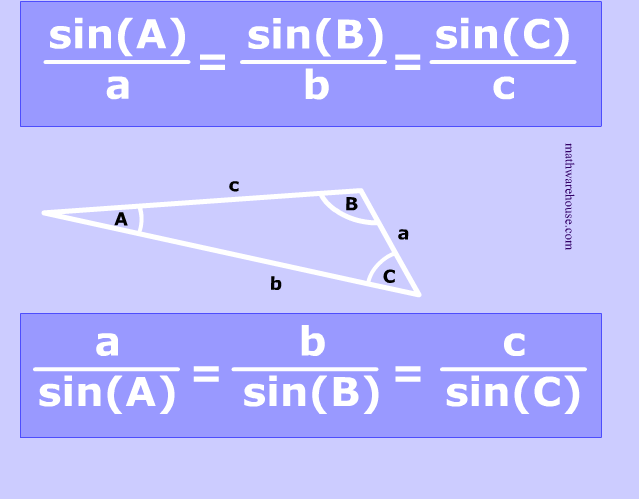
(Google)
4 - Area of an Oblique Triangle
How is the “area of an oblique” triangle derived?
To derive this formula, we are going back to basics! We base this off of our understanding that "1/2(bh) = A." However, since this is not a right triangle, we can no longer use this; at least not that simply.
In the picture above we see the same triangle as before. This visual will aid us in understanding how to derive the formula for the area of an oblique triangle.

By setting up the ratio "sin(C) = h/a" we can then multiply by "a" to get "h" by itself. This will then allow us to substitute "asinC" into the 1/2(bh) = A" formula; leaving us with "1/2(bXasinC) = A"

(extra example of how we can set up the equation)

(example of a problem)
How does it relate to the area formula that you are familiar with?
This relates to the area formula that we are familiar with as it still involves multiplying by half, using the base value, and some form of the half value to come by the area of a triangle. This formula is largely based off of material that we already know; the only change is that we are interchanging the height for a trigonometric function.
Google - http://www.mathwarehouse.com/trigonometry/law-of-sines/images/formula-picture-law-of-sines2.png

No comments:
Post a Comment