Pages

Wednesday, March 26, 2014

SP#7: Unit Q Concept 2: Finding All Trig Functions When Given OneTrigFunction and Quadrant

This SP7 was made in collaboration Anahi C. Please visit the other awesome posts on their blog by going here.

We are given two trig functions to help solve the equation: cos(x) = 8rad89/89 and cot(x) = 8/5. 


In the photo above, we see the use of the reciprocal identities to find tan and sec. Thanks to our identities, we know that tan(x) = 1/cot(x). Since we are given cot, all we have to do is plug in the information to the formula and we receive the trig function of tan. The same process goes towards finding sec as sec(x) = 1/cos(x). Again we plug in the information that has been supplied to come by our answer. We then used the Pythagorean identity of "1-csc^2(x) = -cot^2" to find the value of csc. The negatives cancel out and again we fill in the formula with the information we know. Knowing when to do what (square, divide, etc.) is key to correctly solving this type of identity.

In order to find sin, we once again use the reciprocal identity that equates "sin(x) = 1/cot(x)." Once again we simply fill this out with the information we received from earlier and given steps. It is important that we multiply by the reciprocal in order to receive the correct answer! 

This step shows the use of the inverse trig functions from Unit O. Csc, sec, and cot are simply the reciprocals of the sinc, cos, and tan. Since we already know much of our necessary information, all we have to do is fill in the formulas! csc = r/y -- sec = r/x -- cot = x/y


These steps show the use of the regular trig functions that we learned in Unit O. We fill in the formulas with what we know, simplify, and rationalize. It is important that there are NO square roots in your denominators! sin = y/r -- cos = x/r -- tan = y/x


Here we have our final triangle. In the upper right hand corner, we can see which quadrant the triangle lies within. Since we were given cos and cot, both of which were positive, we were given information that can eliminate possible quadrants. cos must stay within the I and III quadrant while cot must do the same. With all of the info we've found, we can see the final result of the triangle. 


Wednesday, March 19, 2014

I/D3: Unit Q - Pythagorean Identities

I - Inquiry Activity Summary 

1) Before we dive too deep into Pythagorean Identities, it is important to know what an "identity" is. An identity is a proven fact or a formula that is always true. The Pythagorean Theorem is an identity because it is always true! In other words, "x2+y2"will always equal "r2." We can make this equal to one by dividing the entire equation by "r2." This action would yield, "(x/r)2+(y/r)2  = 1." By using these letters, we can relate the Pythagorean Theorem to the unit circle! "x/r" is equivalent to the trig ratio of cosine while "y/r" is the ration for sine. These ratios are created by setting the Pythagorean Theorem equal to one; thereby allowing us to use trig functions in relation. Not only do we achieve our trig functions, but we further our use of Unit Circle knowledge by noticing that the "1" that we set the Pythagorean Theorem to is also the radius of the Circle. From this we can conclude that the two are directly tied together! Since (x/r) is equal to cosine and (y/r) is equal to sine, we can substitute the two ratios for trig functions! In other words, we could change "(x/r)2+(y/r)2  = 1" to "cos2x + sin2x = 1."
This is referred to as the Pythagorean Identity because it is a proven formula that is always true; a formula which equates the Pythagorean Theorem. 

We can see how the values of the unit circle prove that the Pythagorean Identity is legitimate. In the photo above, I used 60 degrees which has a value of (1/2, rad3/2). If we plug this into the identity, square each value, and add them together, we prove that the formula is correct as it equals one.  

2)
a - in order to derive the identity involving Secant and Tangent, you need to divide by cos^2x! this will yield "1 + tan^2x = sec^2x." The ratios are very important in this step. By dividing by sine, you are dividing by ratios. This can lead to changes in ratios which then result in changes to the trig functions!  

b - We follow similar step to derive the identity involving Cosecant and Cotangent! By dividing we yet again yield different ratios and different trig functions resulting in our identity. 


II - Inquiry Activity Reflection 

“The connections that I see between Units N, O, P, and Q so far are…” the repeated references to the unit circle and even the trig functions.

“If I had to describe trigonometry in THREE words, they would be…” unit circles, ratios, and triangles.

Tuesday, March 18, 2014

WPP #13 & 14: Unit P Concept 6 & 7: Law of Sines and Law of Cosines

Please see my WPP13-14, made in collaboration with Alexis T., by visiting their blog here.  Also be sure to check out the other awesome posts on their blog

Sunday, March 16, 2014

BQ# 1: Unit P Concept 1 & 4: Law of Sines and Area of an ObliqueTriangle

1 - Law of Sines 

Why do we need it?

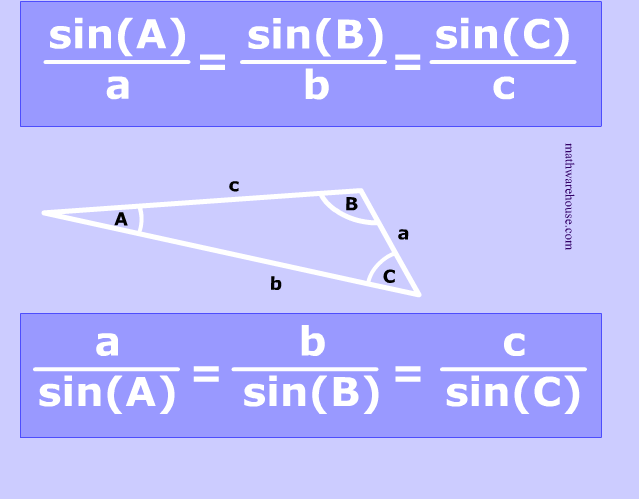
We need the law of sines for various reasons. One reason we need the law of sines is that the trig functions that we have previously learned can only directly apply to a right triangle. That being said, we need to find an alternative to solving our non-right triangles. By using the law of sines, we are enable to find a missing angle, and even go on to find missing sides!

How is it derived from what we already know?


As we already know, a non right triangle cannot use the same trig functions as a right triangle. Therefore we have to find a different means of coming by our answer. In the photo above, we see an oblique triangle labeled "A, B, C, a, b, and c." This is where we start off our derivation of the Law of Sines. In this case, I drew a perpendicular line down from angle B down to side b. I then went on to label the line "x" to help us later on.
Doing this provides two right triangles that we already know how to use. We will then incorporate the trig function of sine to help us derive our formula.
In the picture above, I marked the sides that we will be using in the derivation of the formula. Starting on the left triangle, we will be using "sin(A) = x/c" and on the right triangle we will be using "sin(C) = x/a". (the trig function sine is equal to the opposite side over the hypotenuse)
After the ratios are set up, you then proceed to cancel out the denominators (multiply each sin function with it's denominator ON BOTH SIDES). We are then left with two functions that both equal "x." By using the transitive property, we can set the two equations equal to one another.  
From there, we divide both sides by "ca" in order to result in our formula! We have successfully derived the Law of Sines. This can be done with the other side to yield the same results. :)


Extra Information - 
(Google)

4 - Area of an Oblique Triangle

How is the “area of an oblique” triangle derived?

To derive this formula, we are going back to basics! We base this off of our understanding that "1/2(bh) = A." However, since this is not a right triangle, we can no longer use this; at least not that simply.
In the picture above we see the same triangle as before. This visual will aid us in understanding how to derive the formula for the area of an oblique triangle. 

By setting up the ratio "sin(C) = h/a" we can then multiply by "a" to get "h" by itself. This will then allow us to substitute "asinC" into the 1/2(bh) = A" formula; leaving us with "1/2(bXasinC) = A"


(extra example of how we can set up the equation)
(example of a problem)

How does it relate to the area formula that you are familiar with?

This relates to the area formula that we are familiar with as it still involves multiplying by half, using the base value, and some form of the half value to come by the area of a triangle. This formula is largely based off of material that we already know; the only change is that we are interchanging the height for a trigonometric function.


Sources -
Google - http://www.mathwarehouse.com/trigonometry/law-of-sines/images/formula-picture-law-of-sines2.png


Thursday, March 6, 2014

WPP 12: Unit O Concept 10: Solving angle of elevation and depressionword problems

Introduction: Do You Juana Ride a Roller Coaster? 
(Google)

The Problem:
Juana decided to take a break from baking! Her son Ivan and newly adopted son Julian thought that it would be cool to go to the amusement park as a reward for all of their hard work! The trio decides to go on a ride with a bunch of dips and rises.
a) Before they get on, Ivan, who is at ground level, decides that he wants to measure the angle of elevation to the top of a coaster and comes up with a 58° angle of elevation. If he is standing 42 feet away, what is the height of the roller coaster?
b) The three get on the ride and everything is great! Until they get stuck on the top of the coaster (same as from before). Julian tries to show Ivan how cool he is by figuring out the angle of depression. If the lowest dip of the coaster is 72 feet away, and they travel 57 feet, what is the angle of depression?


The Solution: 


HELPFUL TIPS: 
1) Make sure that your calculator is is in the correct mode! 
2) Remember that you MUST work with your triangles so that you start on the HORIZONTAL axis. 


Tuesday, March 4, 2014

I/D #2: Unit O Concepts 7-8: Derive the SRTs

INQUIRY ACTIVITY SUMMARY: In class, we were each given a worksheet and: a) told to derive the pattern for the 45-45-90 triangle with a side length of one and b) told to derive the pattern for 30-60-90 triangle with a side length of one(based off of an equilateral triangle).


  1. We can easily derive the 30-60-90 triangle from an equilateral triangle! The first step is to draw a vertical perpendicular line. This border will create the angles that we need to work with.
                               
     As you can see, by drawing a line, we have created a 90 degree angle and a 30 degree angle. We know that one angle is 90 degrees because it is perpendicular to the base of the triangle and we know that the other is 30 degrees as we split a previous 60 degree angle into two. Since we split the base in two, we also have to split the value. This leaves us with a base equal to half. We know that the hypotenuse is going to be equal to one because if you look at the un-seperated triangle, it is across from a 60 degree angle which gives us a side value of 1.
                           
    Here we will go on to use the Pythagorean Theorem to find the height.
                                   
    From this, we go on to make the pattern easier to work with by multiplying everything by 2, leaving us with whole numbers. We add "n" to the pattern to make it applicable to other values besides 1! 
                         
                         
  2. The first step that I took was to draw a diagonal line, cutting the square into two identical triangles. From here I went on to label the degrees. Since we know that the shape was a square, that gives us an obvious 90°Knowing this angle, we can easily label the others. The two remaining angles will be 45°. We can also go about this mathematically; as we know that a triangle must add up to 180°, we can subtract 90° and then divide it by two to equally split it. Since two of our angles are congruent, two sides of our triangle will also be congruent. We also know that the two sides are at a value of 1 as stated in the directions.
                                     
     To find the hypotenuse, we will use the 
    Pythagorean Theorem!
                                      
     We add the variable "n" to the pattern as it allows us to apply it to any other number! As long as "n" is constant, the pattern should reflect proportional values. 
                                     

INQUIRY ACTIVITY REFLECTION:
  1. “Something I never noticed before about special right triangles is…” how they came by their patterns! Before learning how to derive them, I used sole memorization to complete work.
  2. "Being able to derive these patterns myself aids in my learning because.." i understand where the patterns are coming from. It also allows me to find the values should i ever forget them (this could be a lifesaver on a test)!