Pages

Thursday, June 5, 2014

BQ#7 - Unit V


Explain in detail where the formula for the difference quotient comes from now that you know! Include all appropriate terminology (secant line, tangent line,h/delta x, etc).

In this unit, we have been utilizing the difference quotient to solve derivatives. This raises the question: "what is a derivative?" Well, the derivative is the slope of the tangent line to a graph (the graph is most commonly referred to as "f(x)" while the derivative is noted as "f'(x)." To better understand what a tangent line is, we should look into secant lines. A secant line is a line that passes through a graph at two points; however, if you were to move those two points closer and closer together, until they meet, you would receive a tangent line - a line that touches the graph only once. In order for a secant line to turn into a tangent line, we must alter the slope. 
http://cis.stvincent.edu/carlsond/ma109/diffquot.html

In the diagram above, we see two lines. Ultimately, our goal is to alter the red secant line in order to create a tangent line. Remember, this involves using slopes! This is where the slope formula () comes into play. However, for this to work, we need points to plug into the formula. Looking at the picture above, we notice that our two points will be (x, f(x)) and (x+h, f(x+h)) {"h" in this equation is solely the difference in space between the two points}. WOO! We now have our two points to plug into the slope formula. The work for this is shown below!

In the picture above, we can see the two points plugged into the formula for a slope. Nothing in the numerator can cancel out. However, we CAN cancel out the "x" on the bottom! This leaves us with our difference quotient!!!! 


Monday, May 19, 2014

BQ#6 - Unit U

1. What is continuity? What is discontinuity?

A continuity is a continuous function. This is defined as a function that is predictable, not having any breaks, jumps, or holes, which can be drawn without lifting your pencil from the paper. This is also seen when the limit and value are the same. A discontinuity is a function in which the intended height and the actual height are not the same. There are two different types of discontinuities: removable and non-removable discontinuities. Removable discontinuities are defined as point discontinuities (basically holes). These are removable due to the fact that the value is removed and placed elsewhere on the graph. On the other hand, non-removable discontinuities include: jump discontinuities, oscillating behavior, and the infinite discontinuity. Jump discontinuities include the use of closed and open circles to represent the value along the functions. A closed circle represents a value while the open circle represents the fact that there is no value at the given point. Oscillating behavior is defined as a non-removable discontinuity because it does not approach an specific point on the graph. Lastly, infinite discontinuities are defined as non-removable because of the vertical asymptotes. The vertical asymptotes create unbounded behavior which then leads to increases or decreases without bound (a discontinuity).
Kirch Math Analysis

2. What is a limit? When does a limit exist? When does a limit not exist? What is the difference between a limit and a value?
A limit is the intended height of a function. This exists if you travel along a function from the left and right side toward some specific value of x, as long as the function meets or the heights from the right and the left are the same, then the limit exists. A limit do not exist at the three non-removable discontinuities (jump, infinite, and oscillating behavior). Jump discontinuities do not have limits because the left ad right behaviors are different. In other words, if you were to trace the function coming from both the left and right sides, you would not end up at the same value, leading to no limit. Limits also cease to exist when we encounter vertical asymptotes (part of infinite discontinuities). This is due to the fact that vertical asymptotes lead to unbounded behavior that cannot be determined as far as limits go. Furthermore, limits do not exist when oscillating behavior takes places. This is the result of not approaches any specific value. Without a specific value it is impossible to determine a limit for a given function.
http://img1.wikia.nocookie.net/__cb20130409141027/socio/images/0/05/The_limit_does_not_exist.gif

The different between a limit and a value is that a limit is the intended height of the function while the value is the actual height of the function.

3. How do we evaluate limits numerically, graphically, and algebraically?

To evaluate a limit numerically, we practice the use of limit tables. Before we get started, if the problem involves a fraction, we can use our prior knowledge of holes. In other words, we can factor out the top and see if a value cancels out with the bottom. If something cancels then we know that we will have a hole. The next step in this process is to then add or subtract 1/10 to our limit; this creates your boundaries for the table. From here, we fill in x values that move close to and away from the limit. After setting this up, we simply plug the equation into our calculators and hit trace until we receive all of our values. 
             For further explanation: 
To evaluate limits graphically, we use graphs and limit statements. This is relatively simple. We place our fingers to the left and right of the point we want to evaluate and move them towards one another. If they touch, then we have a limit. However, if the fingers do not make contact, there is no limit. While doing so, we will be expected to be able to write limits and values. To write our limits, we will phrase it as "f(x) as x approaches  # = __" and to compose our values we write "f(#)=__." This will help us to further analyze what is taking place on the graph. 
             For further explanation: 

To evaluate limits algebraically, we can use direct substitution, dividing out/factoring method, or rationalizing/conjugate method. The first option, direct substitution is the easiest. For this form of evaluation, we simply substitute the given value into the equation and solve. This will result in one of four possible methods: a numerical answer, 0/# resulting in 0, #/0 resulting in an undefined answer, or 0/0 which is indeterminate form. If we receive indeterminate form, we will then have to use the dividing out/factoring method, or rationalizing/conjugate method. When using the dividing out/factoring method, we must factor out the numerator and denominator, then cancel out like terms. After this step, we use direct substitution to find our answer. Why does this work? This works because we are getting rid of the hole in the problem, thereby resulting in a viable answer. Our other option is the rationalizing/conjugate method. Through this method, we multiply the numerator and the denominator by the conjugate of the side that has a radical. When doing so we foil the side from which we derived the conjugate from while the other side remains in parenthesis. This allows us to late cancel out like terms. Once this is done we practice direct substitution to receive our answer. 

Monday, April 21, 2014

BQ#4 – Unit T Concept 3

Why is a “normal” tangent graph uphill, but a “normal” Cotangent graph downhill? Use unit circle ratios to explain.

Tangent and cotangent are both positive in quadrant 1, negative in quadrant 2, positive in quadrant 3, and negative in quadrant 4. To start off with, we know that asymptotes exist whenever we divide by zero. For the graph of tangent, we need to look back at our ratios from the unit circle. Because tangent is equal to "y/x", tangent is going to have asymptotes wherever x equals zero (if "x" equals "0", we will receive an undefined answer). If we look at the graph, we know that the x value equals zero at pi/2 and 3pi/2. These two points will be the points of the asymptotes. With these asymptotes, we know that the graph has to be positive in quadrant 1 and quadrant 3 (ASTC) while it is negative in quadrant two and four. This outcome can only take place if the graph is positive in quadrant one, negative in quadrant two, so on and so forth. This makes the tangent graph uphill!


Cotangent is going to have asymptotes wherever sine equals zero. Yet again we need to look back at our unit circle ratios. Cotangent is positive in quadrant 1, negative in quadrant 2, positive in quadrant 3, and negative in quadrant 4. We also know that cotangent is equals to "y/x" (could be replaced with cos/sin). By looking at the graph, we see that this leads us to zero, pi, and 2pi. These values will become our asymptotes (that is where cotangent will become undefined). Because of the asymptotes and the sin graph, we will have to create a graph that goes from positive to negative to positive to negative. This can only be achieved one way with these asymptotes. this makes the normal cotangent graph downhill!

Saturday, April 19, 2014

BQ#3 – Unit T Concepts 1-3

How do the graphs of sine and cosine relate to each of the others?
Desmos.com - via Kirch Math Analysis

In the graph above, we see three different three different lines: sine(red), cos(blue), and tan (orange). In Quadrant I (the blue section), we see that both the sine and cosine values are positive. Looking back at our identities we know that, tangent equals sine/cosine. if sine and tangent are positive, they will continue to yield positive results. Therefore, tangent is positive in the first quadrant. In the second quadrant, sine is positive and cosine is negative. Knowing that tan = sin/cos, then tangent is going to have to be negative. In quadrant three both sine and cosine are negative. If we divide a negative by a negative we will come to find a positive answer. In quadrant IV, we have sin being negative and cos being positive. If we divide a negative by a positive, tangent is going to be negative. To find our asymptotes, we have to figure out where cosine will equal "0." By looking at the graph we see that cosine equals zero at (pi/2, 0) and (3pi/2, 0). We can see this asymptote as the orange line can not touch the points given. 

desmos.com - via Kirch Math Analysis


In quadrant I, both sine and cosine are positive; this will lead to positive cotangent! Having a positive cotangent creates a graph that starts from the axis and goes up. From here, we should think of our identities. We know that "cot = cos/sin." This means that we will have asymptotes where sin = 0 (0 on bottom = undefined = asymptote). In Quad II, sin is positive while cos is negative. Therefore, if we divide cos by sin, we will receive a negative cotangent. This leads to a negative shift in the graph. In Quad III, cotangent is going to be positive because sin and cos are both negative. As we all know, two negatives make a positive. The final quadrant involves a negative sin value and a positive cos value. Dividing the two together would result in a negative turn in the graph. 

desmos.com - via Kirch Math Analysis


In Quadrant I cosine and secant are both positive. Thanks to our identities, we know that secant is the reciprocal of cosine. So where cos is (0,1), secant is going to be the reciprocal of the value (1). Since we know that secant is the  reciprocal of cos, we know that the asymptotes will be located where cos = 0. In Quadrant II, cosine is negative so secant is negative. We must not forget that the ACTUAL graph will not make contact with the asymptote boundaries. We can see that cosine is positive in Quadrant IV. Therefore, if we follow our ongoing trend, secant is going to have to be positive. We draw the graph from the high and low points of the valleys. These types will always be parabolas that have their set boundaries.
desmos.com - via Kirch Math Analysis

For our cosecant graph, asymptotes and sine values are VERY important. Wherever sin(x) = 0 there will be asymptotes for the cosecant graph. In quadrant 1, our sine value is positive; the same goes for quadrant II. So if sin is positive in both quadrants that means that cosecant will be above the x-axis (we draw csc from the vertex). In quadrant III and IV, we see that our sine value is negative. This means that our cosecant graph will also be negative. As you can see, the entire cosecant graph depends on the vertex and asymptotes of the sine graph. Why does this happen? We know that cosecant = 1/sin, wherever sin(x) = 0. This occurs because when sin=0 we receive the asymptotes that set our cosecant graph's boundaries.


Resources - http://kirchmathanalysis.blogspot.com/p/unit-t.html (Big Question Help)

Thursday, April 17, 2014

BQ#5 – Unit T Concepts 1-3

Why do sine and cosine NOT have asymptotes, but the other four trig graphs do?

To answer this question, we first need to look at the ratios of the trig functions we are dealing with! These ratio include: sine, cosine, cosecant, secant, tangent, and cotangent.
Kirch Math Analysis

When looking at the ratios, we see that sine and cosine are the only two trig functions that have "r" as the denominator. From our previous work with the unit circle, we know that "r" is equal to "1" as that is it is the variable for the radius of the circle. Knowing that this denominator will always be "1," we can conclude that there will never be an undefined value. {to receive and undefined value, we must have a "0" in the denominator; however, as there is a "1," the chance of this happening is eliminated.}The remaining four trigonometric functions contains "x" and "y" values in the denominator. These values could possible have a "0" in the denominator which would lead to the creation of asymptotes.

Wednesday, April 16, 2014

BQ#2 – Unit T Concept Intro

How do trig graphs relate to the unit circle?
Trig graphs are largely related to the unit circle! This can be seen in the formation of the graphs and the curves that accompany specific trigonometric functions. Each trig function correlates to a quadrant on the unit circle. This creates zones of positive and negative values. These values are reflected throughout trig graphs as the curvature of the lines follows the specific guides. The "all students take calculus" technique still applies! If we were to unravel the unit circle, the positive and negative quadrants would still apply to the trig functions.

Period?- Why is the period for sine and cosine 2π, whereas the period for tangent and cotangent is π ?
The period for sine and cosine is 2π because that is how long it take to repeat the pattern! The pattern that applies to sine is "++--" while cosine refers to "+--+" In order to complete these patterns (or make a full rotation around the circle) you would need to use all four quadrants. As we know from our unit circle knowledge, a full revolution around the circle is 360 degrees OR 2π! That being said, it would take 2π to complete the necessary pattern. The period for tangent and cotangent is π because you only need half of the unit circle to create a period. This is because the tan and cot pattern can be created with only half of the unit circle; half of the unit circle is equal to π.

Amplitude? – How does the fact that sine and cosine have amplitudes of one (and the other trig functions don’t have amplitudes) relate to what we know about the Unit Circle?

In order to answer this question, we should think back to what we know about the unit circle. From previous lessons, we have learned that the unit circle has a radius of 1. We have learned that the trig function for sine is equal to "y/r" and cosine is equal to "x/r." If "r" - the radius - is 1, that means that the numerator would have to be a value that is less than 1. We also know that sine and cosine have limitations within the circle. The two must be smaller than both -1 and 1. If sine and cosine cannot pass the value of "1" in either direction on the unit circle, they won't be able to pass them on a regular graph (remember that a trig graph is just the unit circle unraveled). That being said, the two trig functions are restricted to the y values of 1 and -1. This is the equivalent to having amplitudes of 1 and -1.

Friday, April 4, 2014

Reflection #1 - Unit Q: Verifying Trig Identities

I - What does it actually mean to verify a trig identity? 

Verifying a trig identity is one of the easier things to do throughout this concept. What it means, is that you have to take the given problem, and simplify it so that the left side is equal to the right side. In other words, you verify that one side equals the other even if they are formatted differently. 

II - What tips and tricks have you found helpful?

Starting off this unit, you will most likely feel extremely confused and probably won't want to touch an identity. It gets easier! Sort of... Something that really helps get problems done quickly is knowing all of your identities (ratio, reciprocal, and Pythagorean)! Knowing identities by heart will speed up the process of simplifying as you know what you want to get to in order to solve the problem. This will also prevent you from having to search through the SSS to find ways to work out the problems. One of the most important tips any Math Analysis student could give incoming identity solvers is to not give up! It is obvious that this is one, if not the most, of the more challenging units of the year; that just means that you need to push through it to succeed. Study, do your PQ's, and practice in order to do well on the test. As far as tricks go, don't be afraid of pulling out a GCF, substituting an identity, or playing with fractions! These steps will help you conquer the beast that is mathematical identities. 

III - Explain your thought process and steps you take in verifying a trig identity.

As soon as I look at my problem, the first thing I need to do is see what I'm working with. "Do I need to verify or solve?" The next step would be to then see if I should be pulling out a factor from the problem. If i need to, then I proceed to pull out the factor and attempt to set the problem equal to zero so that I can use the Zero Product Property. The next step would be to go on to see if anything can be simplified into a Pythagorean Identity. If something can be, then I go ahead and substitute one for the other. This may help us cancel out some parts of our problem. Depending on the problem, this may be enough to find your answer. However, dealing with fractions can cause some difficulty. When I come across fractions, I do the same steps as earlier, but then also take into the account the denominator. If there is a binomial on the bottom, we can multiply by the conjugate in an attempt to make our fractions a little easier to work with. If there is a monomial in the denominator, we can go ahead and split the fraction into two separate fractions. From these two steps, we can go on to factor our problem! These should all be accompanied by and explanation on the right hand side of the paper! With that, good luck to the future math analysis students!

Wednesday, March 26, 2014

SP#7: Unit Q Concept 2: Finding All Trig Functions When Given OneTrigFunction and Quadrant

This SP7 was made in collaboration Anahi C. Please visit the other awesome posts on their blog by going here.

We are given two trig functions to help solve the equation: cos(x) = 8rad89/89 and cot(x) = 8/5. 


In the photo above, we see the use of the reciprocal identities to find tan and sec. Thanks to our identities, we know that tan(x) = 1/cot(x). Since we are given cot, all we have to do is plug in the information to the formula and we receive the trig function of tan. The same process goes towards finding sec as sec(x) = 1/cos(x). Again we plug in the information that has been supplied to come by our answer. We then used the Pythagorean identity of "1-csc^2(x) = -cot^2" to find the value of csc. The negatives cancel out and again we fill in the formula with the information we know. Knowing when to do what (square, divide, etc.) is key to correctly solving this type of identity.

In order to find sin, we once again use the reciprocal identity that equates "sin(x) = 1/cot(x)." Once again we simply fill this out with the information we received from earlier and given steps. It is important that we multiply by the reciprocal in order to receive the correct answer! 

This step shows the use of the inverse trig functions from Unit O. Csc, sec, and cot are simply the reciprocals of the sinc, cos, and tan. Since we already know much of our necessary information, all we have to do is fill in the formulas! csc = r/y -- sec = r/x -- cot = x/y


These steps show the use of the regular trig functions that we learned in Unit O. We fill in the formulas with what we know, simplify, and rationalize. It is important that there are NO square roots in your denominators! sin = y/r -- cos = x/r -- tan = y/x


Here we have our final triangle. In the upper right hand corner, we can see which quadrant the triangle lies within. Since we were given cos and cot, both of which were positive, we were given information that can eliminate possible quadrants. cos must stay within the I and III quadrant while cot must do the same. With all of the info we've found, we can see the final result of the triangle. 


Wednesday, March 19, 2014

I/D3: Unit Q - Pythagorean Identities

I - Inquiry Activity Summary 

1) Before we dive too deep into Pythagorean Identities, it is important to know what an "identity" is. An identity is a proven fact or a formula that is always true. The Pythagorean Theorem is an identity because it is always true! In other words, "x2+y2"will always equal "r2." We can make this equal to one by dividing the entire equation by "r2." This action would yield, "(x/r)2+(y/r)2  = 1." By using these letters, we can relate the Pythagorean Theorem to the unit circle! "x/r" is equivalent to the trig ratio of cosine while "y/r" is the ration for sine. These ratios are created by setting the Pythagorean Theorem equal to one; thereby allowing us to use trig functions in relation. Not only do we achieve our trig functions, but we further our use of Unit Circle knowledge by noticing that the "1" that we set the Pythagorean Theorem to is also the radius of the Circle. From this we can conclude that the two are directly tied together! Since (x/r) is equal to cosine and (y/r) is equal to sine, we can substitute the two ratios for trig functions! In other words, we could change "(x/r)2+(y/r)2  = 1" to "cos2x + sin2x = 1."
This is referred to as the Pythagorean Identity because it is a proven formula that is always true; a formula which equates the Pythagorean Theorem. 

We can see how the values of the unit circle prove that the Pythagorean Identity is legitimate. In the photo above, I used 60 degrees which has a value of (1/2, rad3/2). If we plug this into the identity, square each value, and add them together, we prove that the formula is correct as it equals one.  

2)
a - in order to derive the identity involving Secant and Tangent, you need to divide by cos^2x! this will yield "1 + tan^2x = sec^2x." The ratios are very important in this step. By dividing by sine, you are dividing by ratios. This can lead to changes in ratios which then result in changes to the trig functions!  

b - We follow similar step to derive the identity involving Cosecant and Cotangent! By dividing we yet again yield different ratios and different trig functions resulting in our identity. 


II - Inquiry Activity Reflection 

“The connections that I see between Units N, O, P, and Q so far are…” the repeated references to the unit circle and even the trig functions.

“If I had to describe trigonometry in THREE words, they would be…” unit circles, ratios, and triangles.

Tuesday, March 18, 2014

WPP #13 & 14: Unit P Concept 6 & 7: Law of Sines and Law of Cosines

Please see my WPP13-14, made in collaboration with Alexis T., by visiting their blog here.  Also be sure to check out the other awesome posts on their blog

Sunday, March 16, 2014

BQ# 1: Unit P Concept 1 & 4: Law of Sines and Area of an ObliqueTriangle

1 - Law of Sines 

Why do we need it?

We need the law of sines for various reasons. One reason we need the law of sines is that the trig functions that we have previously learned can only directly apply to a right triangle. That being said, we need to find an alternative to solving our non-right triangles. By using the law of sines, we are enable to find a missing angle, and even go on to find missing sides!

How is it derived from what we already know?


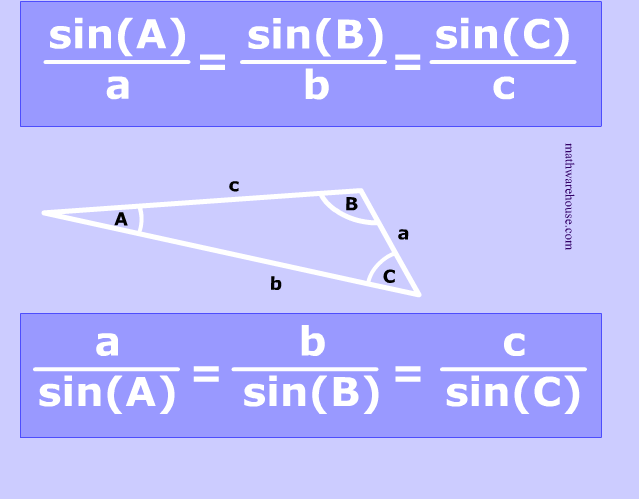
As we already know, a non right triangle cannot use the same trig functions as a right triangle. Therefore we have to find a different means of coming by our answer. In the photo above, we see an oblique triangle labeled "A, B, C, a, b, and c." This is where we start off our derivation of the Law of Sines. In this case, I drew a perpendicular line down from angle B down to side b. I then went on to label the line "x" to help us later on.
Doing this provides two right triangles that we already know how to use. We will then incorporate the trig function of sine to help us derive our formula.
In the picture above, I marked the sides that we will be using in the derivation of the formula. Starting on the left triangle, we will be using "sin(A) = x/c" and on the right triangle we will be using "sin(C) = x/a". (the trig function sine is equal to the opposite side over the hypotenuse)
After the ratios are set up, you then proceed to cancel out the denominators (multiply each sin function with it's denominator ON BOTH SIDES). We are then left with two functions that both equal "x." By using the transitive property, we can set the two equations equal to one another.  
From there, we divide both sides by "ca" in order to result in our formula! We have successfully derived the Law of Sines. This can be done with the other side to yield the same results. :)


Extra Information - 
(Google)

4 - Area of an Oblique Triangle

How is the “area of an oblique” triangle derived?

To derive this formula, we are going back to basics! We base this off of our understanding that "1/2(bh) = A." However, since this is not a right triangle, we can no longer use this; at least not that simply.
In the picture above we see the same triangle as before. This visual will aid us in understanding how to derive the formula for the area of an oblique triangle. 

By setting up the ratio "sin(C) = h/a" we can then multiply by "a" to get "h" by itself. This will then allow us to substitute "asinC" into the 1/2(bh) = A" formula; leaving us with "1/2(bXasinC) = A"


(extra example of how we can set up the equation)
(example of a problem)

How does it relate to the area formula that you are familiar with?

This relates to the area formula that we are familiar with as it still involves multiplying by half, using the base value, and some form of the half value to come by the area of a triangle. This formula is largely based off of material that we already know; the only change is that we are interchanging the height for a trigonometric function.


Sources -
Google - http://www.mathwarehouse.com/trigonometry/law-of-sines/images/formula-picture-law-of-sines2.png


Thursday, March 6, 2014

WPP 12: Unit O Concept 10: Solving angle of elevation and depressionword problems

Introduction: Do You Juana Ride a Roller Coaster? 
(Google)

The Problem:
Juana decided to take a break from baking! Her son Ivan and newly adopted son Julian thought that it would be cool to go to the amusement park as a reward for all of their hard work! The trio decides to go on a ride with a bunch of dips and rises.
a) Before they get on, Ivan, who is at ground level, decides that he wants to measure the angle of elevation to the top of a coaster and comes up with a 58° angle of elevation. If he is standing 42 feet away, what is the height of the roller coaster?
b) The three get on the ride and everything is great! Until they get stuck on the top of the coaster (same as from before). Julian tries to show Ivan how cool he is by figuring out the angle of depression. If the lowest dip of the coaster is 72 feet away, and they travel 57 feet, what is the angle of depression?


The Solution: 


HELPFUL TIPS: 
1) Make sure that your calculator is is in the correct mode! 
2) Remember that you MUST work with your triangles so that you start on the HORIZONTAL axis. 


Tuesday, March 4, 2014

I/D #2: Unit O Concepts 7-8: Derive the SRTs

INQUIRY ACTIVITY SUMMARY: In class, we were each given a worksheet and: a) told to derive the pattern for the 45-45-90 triangle with a side length of one and b) told to derive the pattern for 30-60-90 triangle with a side length of one(based off of an equilateral triangle).


  1. We can easily derive the 30-60-90 triangle from an equilateral triangle! The first step is to draw a vertical perpendicular line. This border will create the angles that we need to work with.
                               
     As you can see, by drawing a line, we have created a 90 degree angle and a 30 degree angle. We know that one angle is 90 degrees because it is perpendicular to the base of the triangle and we know that the other is 30 degrees as we split a previous 60 degree angle into two. Since we split the base in two, we also have to split the value. This leaves us with a base equal to half. We know that the hypotenuse is going to be equal to one because if you look at the un-seperated triangle, it is across from a 60 degree angle which gives us a side value of 1.
                           
    Here we will go on to use the Pythagorean Theorem to find the height.
                                   
    From this, we go on to make the pattern easier to work with by multiplying everything by 2, leaving us with whole numbers. We add "n" to the pattern to make it applicable to other values besides 1! 
                         
                         
  2. The first step that I took was to draw a diagonal line, cutting the square into two identical triangles. From here I went on to label the degrees. Since we know that the shape was a square, that gives us an obvious 90°Knowing this angle, we can easily label the others. The two remaining angles will be 45°. We can also go about this mathematically; as we know that a triangle must add up to 180°, we can subtract 90° and then divide it by two to equally split it. Since two of our angles are congruent, two sides of our triangle will also be congruent. We also know that the two sides are at a value of 1 as stated in the directions.
                                     
     To find the hypotenuse, we will use the 
    Pythagorean Theorem!
                                      
     We add the variable "n" to the pattern as it allows us to apply it to any other number! As long as "n" is constant, the pattern should reflect proportional values. 
                                     

INQUIRY ACTIVITY REFLECTION:
  1. “Something I never noticed before about special right triangles is…” how they came by their patterns! Before learning how to derive them, I used sole memorization to complete work.
  2. "Being able to derive these patterns myself aids in my learning because.." i understand where the patterns are coming from. It also allows me to find the values should i ever forget them (this could be a lifesaver on a test)!

Saturday, February 22, 2014

I/D #1: Unit N Concept 7: How do Special Right Triangles and the Unit Circle relate?

INQUIRY ACTIVITY SUMMARY:
The Activity - The activity we did in class required us to use prior knowledge of special right triangles or this website called Google to fill out the three different types of special right triangles. When filling out this worksheet we had to: label the sides of the triangles, simplify the sides so that the hypotenuse is equal to 1, label the sides with variables(hypotenuse - r, horizontal value - x, vertical value - y). We then drew a coordinate plane for each triangle(the origin being located at the angle measure), and lastly label all three vertices of the right triangles.

1. 30°  Special Right Triangle - please watch my video on how to complete the 30° Special Right Triangle here (template)

2. 45° Special Right Triangle - please watch my video on how to complete the 45° Special Right Triangle here (template)

3. 60° Special Right Triangle - please watch my video on how to complete the 45° Special Right Triangle here (template)

4. This activity helps us derive the unit circle because these three triangle make up THE MAGIC 5 POINTS aka the first quadrant of the circle. The first quadrant of the unit circle is composed of the x-axis, three coordinates (the vertices of the special right triangles), and the y-axis. The three vertical coordinates are the three ordered pairs in the first quadrant of the unit circle! Knowing this, and knowing that the unit circle repeats these coordinates helps us to figure out the ordered pairs around the entire circle. We also get to see how these number are retrieved and how they came to be which is more beneficial than sole memorization of ordered pairs.

5. This activity lies all of the triangles in the Quadrant I (the triangles are placed on the positive quadrant near the origin). These values would change based on their positive and negative signs, depending on which quadrant they were placed in. This can be seen in the picture below..

 
Each quadrant changes the positive and negative signs. Quadrant II changes the ordered pair to have a negative x-value, Quadrant III gives the ordered pair a negative x and x-value, and Quadrant IV changes the ordered pair to have a negative y-value. This is just like any other graph using quadrants and ordered pairs.

INQUIRY ACTIVITY REFLECTION:


1. The coolest thing i learned from this activity was how the ordered pairs came to be. Before hand, they were only number that i had to memorize, but being able to derive them increases my understanding of the concept.

2. This activity will help me in this unit because it shows how we come by the ordered pairs. It also saves me time as i only have to know the Magic Five to solve problems, instead of filling out an entire unit circle.

3. Something I never realized about special right triangles and the unit circle is that there are special right triangles in the unit circle! Before this concept, I either completely forgot that there are special right triangles in the unit circle or I just didn't know.


Works Cited:
Templates: Kirch Math Analysis - https://docs.google.com/viewer?a=v&pid=sites&srcid=ZGVmYXVsdGRvbWFpbnxkb2NzZm9ya2lyY2hzY2xhc3Nlc3xneDo2YWZmYWE5OTk2OTM5MTFl or kirchmathanalysis.blogspot.com